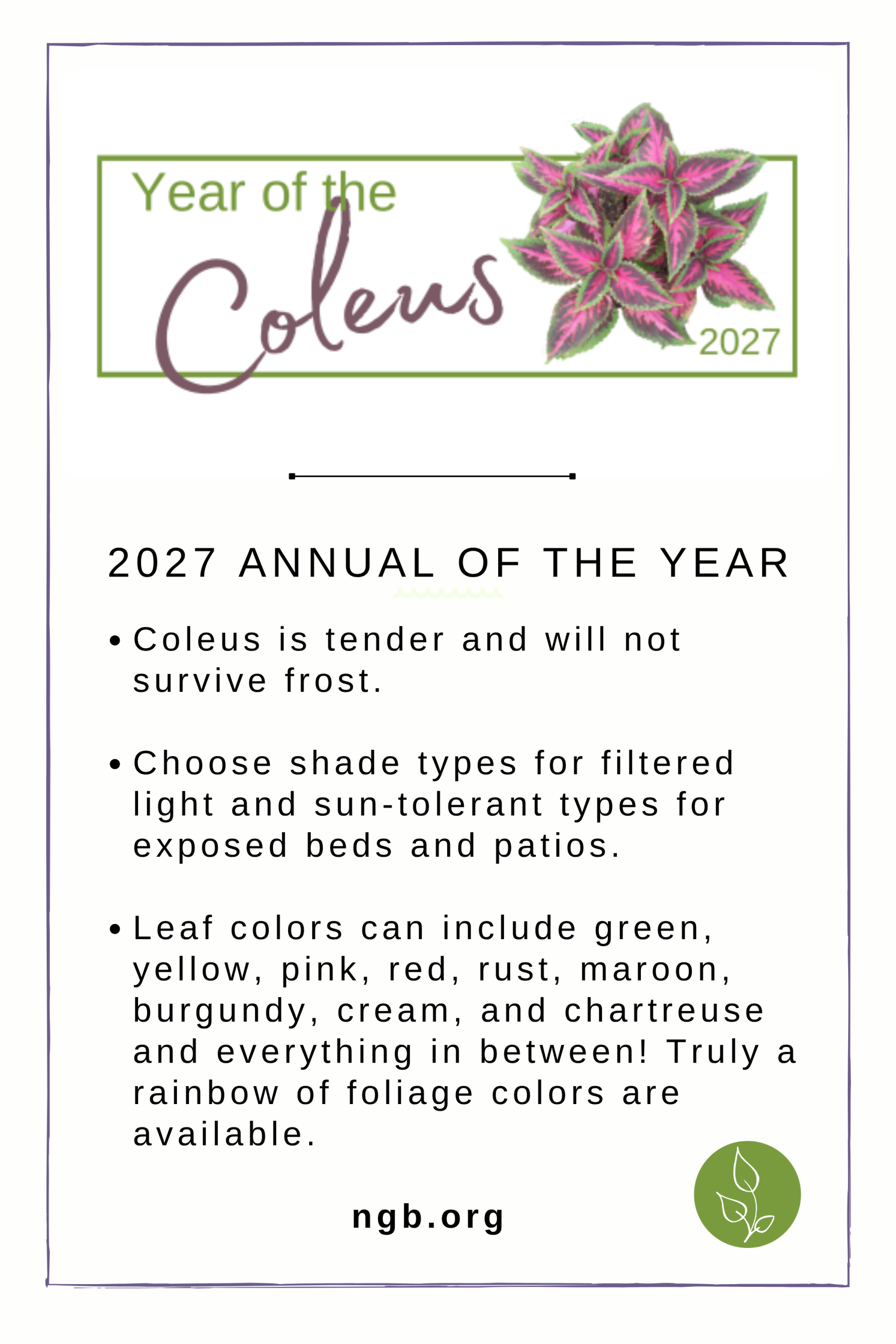
Year of the Coleus

2027 is the Year of the Coleus

The National Garden Bureau (NGB) has named 2027 the Year of the Coleus. Each year, NGB’s “Year of the” program highlights plants that are easy to grow, genetically diverse, and full of new breeding for home gardeners to discover. Coleus was last honored in 2015. It returns because breeders have since introduced dozens of new series with more sun and heat tolerance, longer-lasting color, and later flowering. Today’s coleus grows well in full shade, full sun, garden beds, containers, and hanging baskets.

Growing Guide: Types, Sun and Shade Care, Varieties and FAQs

Coleus is a colorful foliage plant grown for vivid leaves in sun, shade, garden beds, and containers. This Coleus guide explains the basic types of coleus, notable seed-grown and vegetative series, and the light, soil, water, and maintenance practices that help coleus thrive.

Overview and History

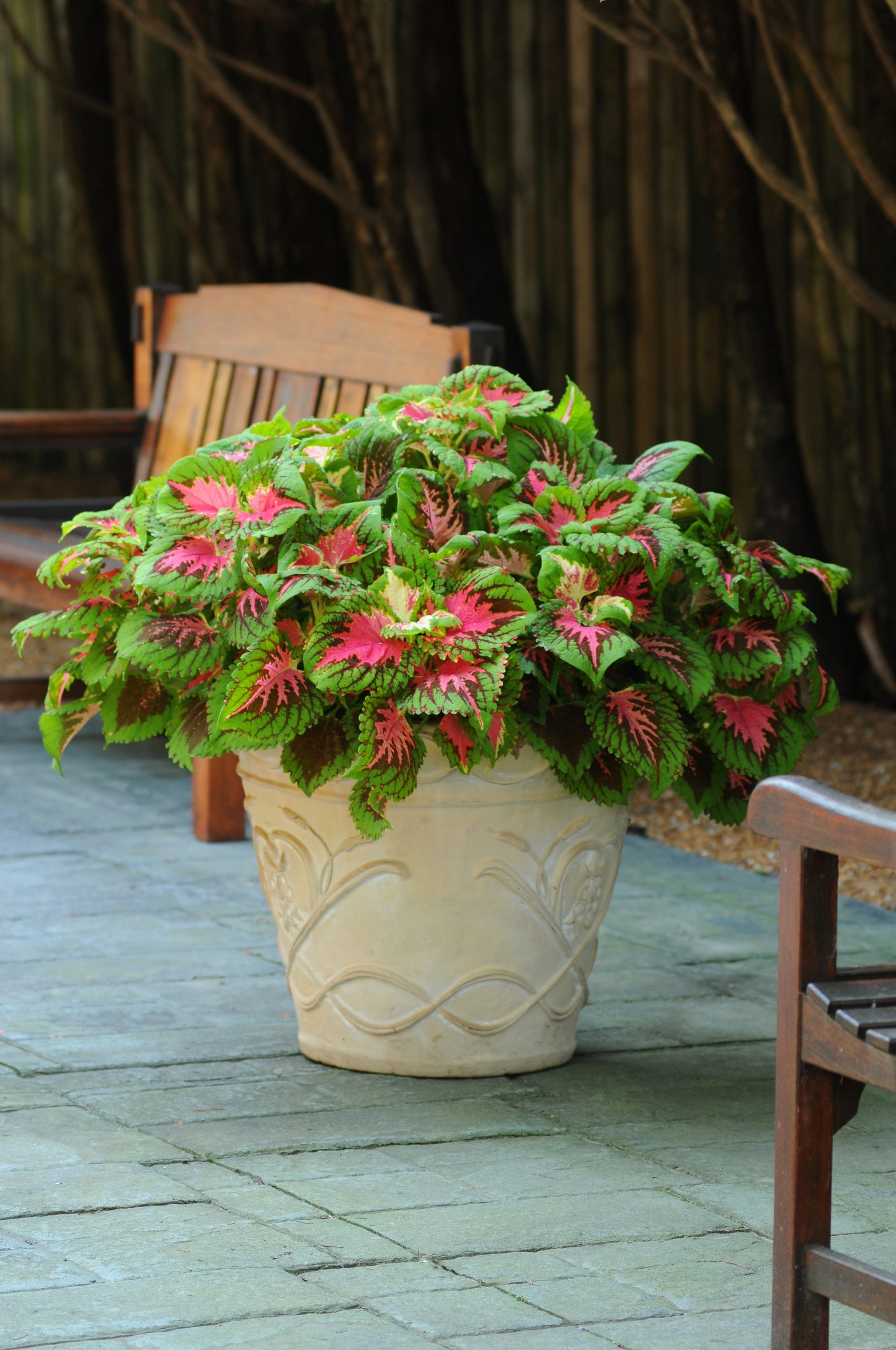
Coleus is the ornamental foliage plant that makes shade—and now many sunny gardens—look intentionally designed. The modern ornamental crop is grown for leaves rather than flowers, with patterns that can look painted, veined, ruffled, scalloped, or quilted in chartreuse, burgundy, copper, rose, red, cream, and nearly black.

Botanically, coleus belongs to the mint family, Lamiaceae, which explains its square stems. The native range is tropical and subtropical Asia to northern Australia. The plant was formerly classified as Solenostemon scutellarioides or Plectranthus scutellarioides; its current name is Coleus scutellarioides.

In plain gardener language: if a label says Coleus, Solenostemon, or Plectranthus scutellarioides, it is pointing to the same familiar foliage powerhouse. Tiny flowers may appear late in the season, but the leaf show is the main event.

Year of Coleus Did You Know is part of the mint family.
Year of Coleus Did You Know Collectors competed to find the most exotic leaf patterns.
Year of Coleus Did You Know coleus flowers signal to the plant that its life is ending.
Year of Coleus Did You Know full sun varieties have more intense colors.

Basic Coleus Types and what are they used for?

Coleus types are best explained by propagation method, garden use, and light tolerance.

Seed-grown coleus gives gardeners economical access to color. Kong is known for large leaves and shade performance, while Wizard is a tidy bedding type around 12 to 14 inches tall. Mezmerize™ is also a seed series bred for sun and heat tolerance, good branching, upright habit, late flowering, and 12- to 20-inch garden dimensions. Premium Sun is also good for sunny areas and offers great garden performance.

Vegetatively propagated coleus are produced from cuttings. These selections are usually chosen for very specific leaf color, pattern, habit, and late flowering. Many breeders organize their cutting-grown coleus by habit, ranging from compact to vigorous and even trailing types, making them a very versatile plant for use in the garden, containers, mixed combos, and even in hanging baskets and window boxes.

Anyone gardening with coleus should be aware of the sunlight reaching their intended planting area, then match the plant to the light. Older coleus were usually treated as shade or part-shade annuals. However, new introductions have been selected for increased sun and heat tolerance. Some varieties still color best in filtered light, while sun-tolerant lines can carry color into hotter exposures when soil moisture is steady.

Popular Coleus Varieties and Series

There are so many coleus available now that the following examples represent popular choices with a range of plant sizes, growth habits, and light tolerances. Note: Many vegetative coleus varieties are patented, so propagating them for sale isn’t allowed.

Vegetative Varieties: Grown from cuttings

  • Talavera™ is a vegetative coleus series with six vigorous varieties for sun or shade, garden beds, and combination planters: Moondust, Sienna, Burgundy Lime, Chocolate Mint, Chocolate Velveteen, and Pink Tricolor.
  • The MicroBlaze™ collection includes 12-18” tall Matchsticks and Spitfire, known for being very compact with striking foliage coloration.
  • The Ignite™ collection includes Copperhead, Heartbreaker, Ruby Slipper and Special Effects ranging from 14 to 16” in height and width.
  • The ChargedUp™ collection, defined as a medium-sized collection, comes in 11 beautiful leaf patterns and colors and stands 14-28” tall and spreads up to 24”.
  • FlameThrower™ is another medium-sized series for containers and garden beds. Cajun Spice comes in at 12 to 18 inches tall and 16 to 18 inches wide, with suitability for sun or shade. Other colors include Adobo Pink, Sriracha, Salsa Roja, Serrano, Salsa Verde, Habanero, Chili Pepper, Chipotle, and Spiced Curry.
  • The TrailBlazer™ Collection is a medium-vigor trailing coleus (6-10” tall and 18-24” wide) that comes in two colors: Glory Road and Road Trip. Both have a cascading habit perfect for hanging baskets, window boxes, and containers.
  • The Volcanica™ Collection is defined as a vigorous collection that comes in 7 colors and grows up to 36” tall and 28” across.
  • Down Town® is a compact coleus series at 12-20” tall with finely textured, multi-toned foliage, and both sun and shade tolerance, giving big pattern impact in small spaces.
  • Great Falls® is a trailing coleus for mixed containers and hanging baskets in both sun and shade, with uniform semi-compact plants that bring cascading color without flowers.
  • Stained Glassworks® is a brightly-colored, fun-textured coleus for shade combination plantings or mono-pots that give jewel-tone foliage for shady areas.
  • Main Street® is an industry standard for both garden and landscape performance, with full sun or full shade performance, large habits, long-season color and very late flowering. The varieties include Abbey Road, Alligator Alley, Beale Street (AAS Winner), Bourbon Street, Broad Street, River Walk, Rodeo Drive, Ruby Road, Sunset Boulevard, Venice Boulevard, and Wall Street.
  • The ColorBlaze series comes in a whopping 19 color and leaf variations and is subgrouped into the tall/upright types, mounding types, and trailing/cascading varieties.
  • GardenFest and GardenScape series. GardenFest is known for being densely branched and durable and comes in four colors. GardenScape is known for its striking colors that are very sun tolerant and comes in 5 colors.
  • TerraScape series is known for its striking, multi-color leaves and strong garden performance.
  • The Partytime series are compact plants that are dense and sturdy with semi-trailing habits that come in 8 colors.

Seed Varieties: 

  • Mezmerize™ is a seed-grown series described as both sun- and heat-tolerant, upright, well-branched, late-flowering, and 12 to 20 inches tall and wide.
  • The Kong series features large leaves, prefers partial sun to filtered sunlight, and is available from many online seed sources as well as your favorite garden retailer.
  • The Wizard series is a compact bedding type of coleus available in several colors or mixes. Wizard is a reliable seed-grown option for mass planting and beginner-friendly color.
  • The Premium Sun series is bred specifically for those sunny areas where bright foliage is desired. This series comes in 11 colors including the AAS Winner Coral Candy.

See photos of these varieties in our Coleus Pictures Gallery.

Special Offers

Wizard Mix Coleus from PanAmerican Seedf
Coleus Mezmerize Chocolate Lime from Syngenta
Coleus tshirt

“Year of the Coleus” Swag

Shop for “Year of the Coleus” gifts, clothing and products on RedBubble.

Growing Happy, Healthy Coleus

Start with the right plants for the right place

For shade gardens, look for labels that say shade or part shade, especially for large-leaf seed types such as Kong. For hot patios or exposed beds, choose sun-tolerant series such as Mezmerize™ or Talavera™, sun/shade FlameThrower™ selections, or Main Street and Great Falls® lines.

What type of Coleus plant to look for when buying

Choose stocky plants with strong color, firm stems, and no signs of wilting. Avoid plants sitting in soggy trays.

Where to plant Coleus

Coleus wants good drainage, whether in the ground or in containers. In beds, improve heavy soil before planting. In pots, use a well-drained container mix and a pot with drainage holes. Poor drainage and excessive watering can lead to stunted plants, muddy brown leaves, and scorched margins.

When to water Coleus

Water thoroughly at planting. For the first week or so, keep the root ball moist but not waterlogged. After establishment, water when the top inch of soil is dry. Containers dry faster than garden soil, especially in midsummer, so check pots often. Water at the base when possible; drip irrigation or a soaker hose keeps foliage drier and helps reduce fungal disease pressure.

Creating a fuller Coleus plant

Pinch young coleus to encourage branching and dense foliage. Many modern vegetative lines are naturally well-branched, but a light pinch can still shape a container. If flower spikes appear and you prefer foliage, shear or pinch them off. Allowing seed set (by not removing the flowers) can make plants decline, while removing flowers can extend performance.

What fertilizer is best for Coleus plants

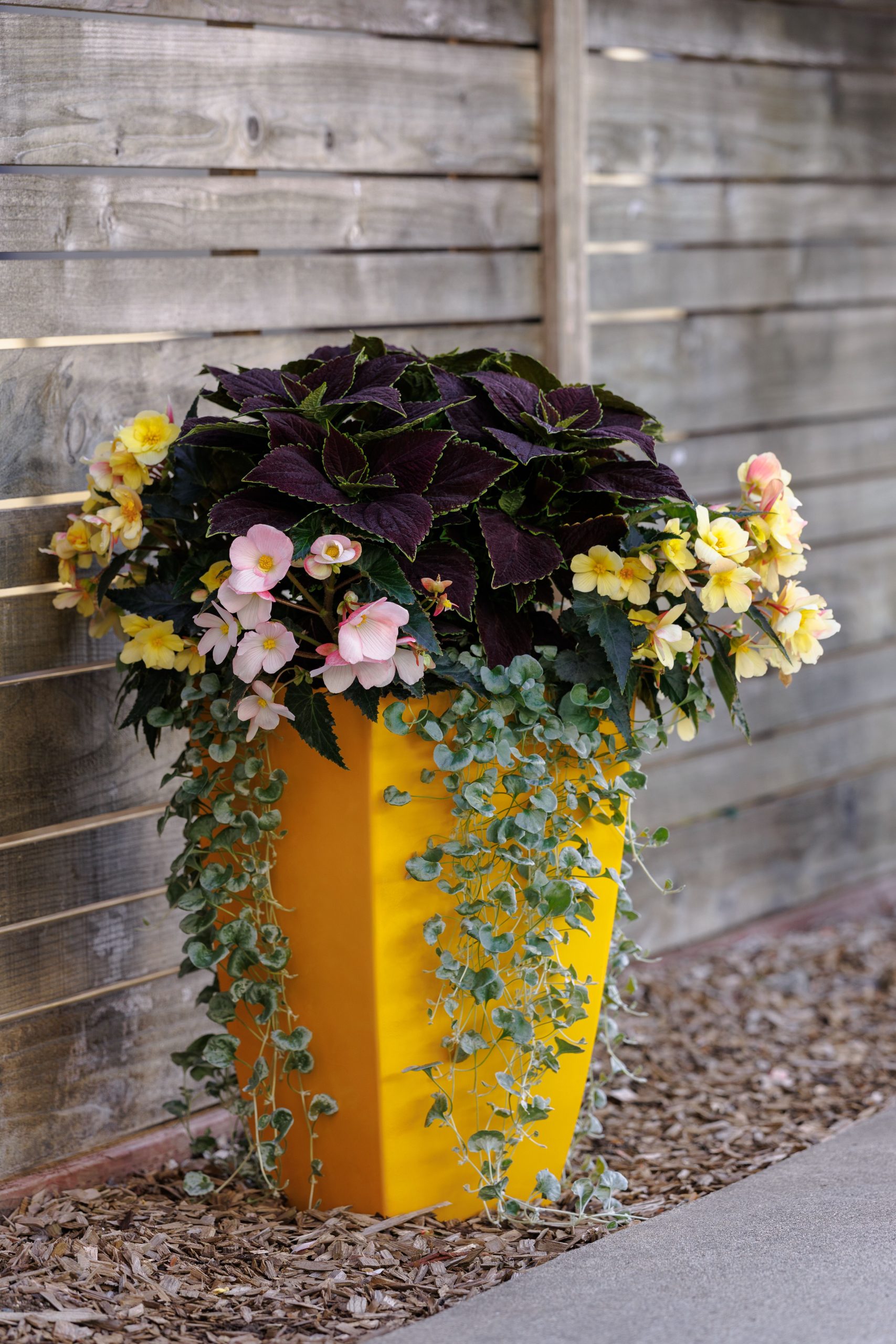
Feed for foliage rather than blooms. An all-purpose soluble fertilizer is recommended throughout the growing season. Avoid bloom-promoting, high-phosphorus formulas because they can encourage legginess and flowering. In mixed containers, pair coleus with plants that like similar moisture and light. Excellent partners include begonias, impatiens, sweet potato vine, caladium, ornamental grasses, and shade-tolerant annuals. Coleus are tender. In cold-winter regions, frost ends the outdoor show.


Year of Coleus Did You Know a sport is part of a plant that suddenly shows a different morphological character.
Year of Coleus Did You Know can be trained into a topiary tree.
Year of Coleus a single plant can look very different depending on where it's planted.
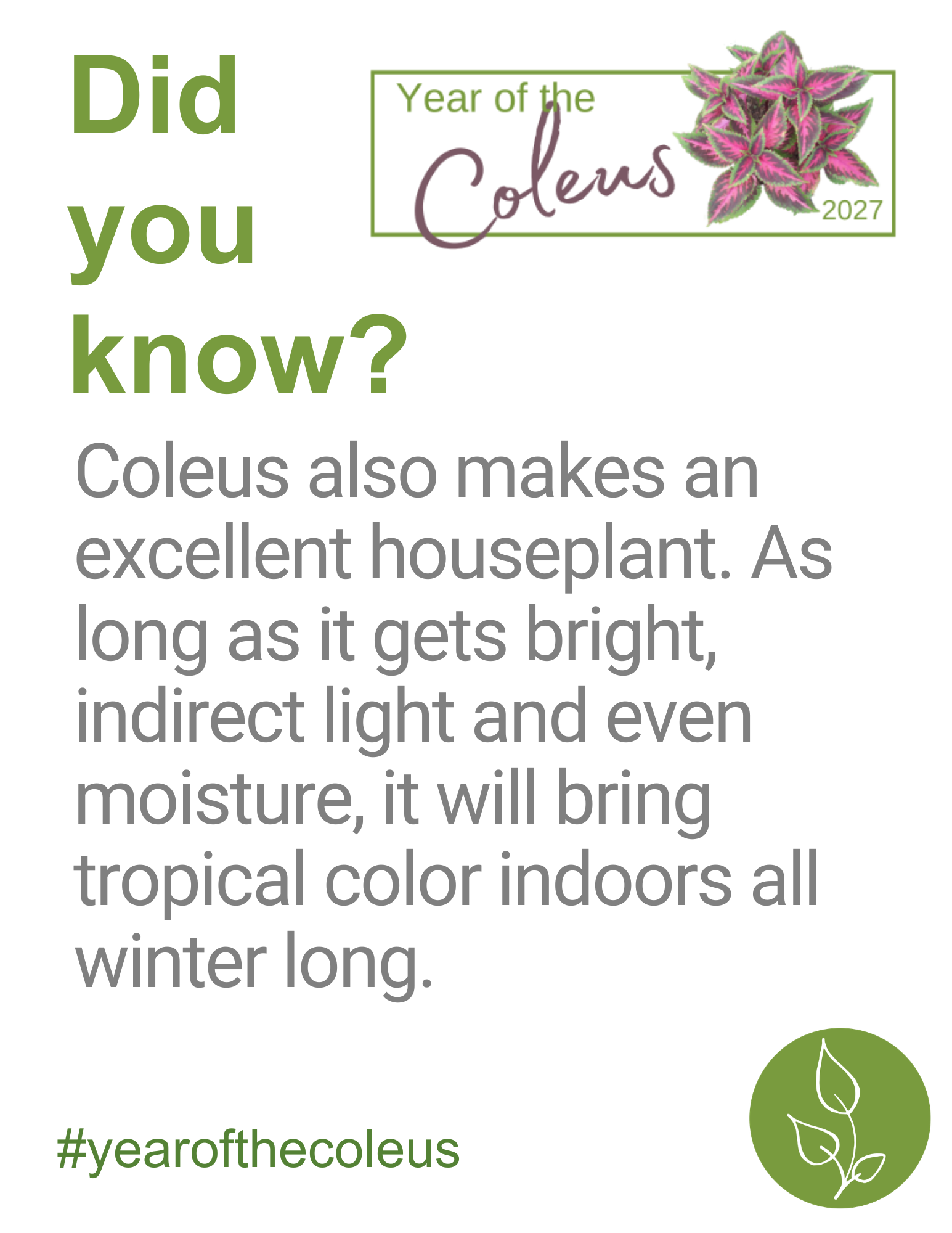
Year of Coleus Did You Know makes an excellent houseplant as long as it gets bright indirect light.

Top Coleus FAQs

Coleus can be grown in both sun and shade depending on the variety. Choose shade types, like Kong, for filtered light, and sun-tolerant series, like Mezmerize™ or Main Street®, for exposed beds and patios. Check the plant label for the light conditions each cultivar was bred for.

Transplant coleus after the danger of frost has passed and warm nights have arrived.

Use well-drained soil or potting mix for coleus as they like consistent moisture but do not tolerate waterlogged roots.

Water Coleus when the top inch of soil or potting mix is dry. Check containers often in summer, since leafy coleus uses water quickly in hot weather. Water near the soil line to keep the foliage dry and reduce the risk of fungal disease.

Pinch young Coleus plants once or twice if you want a fuller, bushier shape.  Many modern varieties branch well naturally.

Remove coleus flower spikes when foliage quality matters more than blooms. This can help the plant maintain a tidy appearance and extend its foliage display.

Use an all-purpose fertilizer from June through August. A bloom-booster formula, may encourage legginess and flowering.

Coleus is tender and will not survive frost. In cold-winter regions, treat it as an annual or bring healthy plants indoors before freezing temperatures arrive.

Yes. The ASPCA lists coleus as toxic to dogs, cats, and horses because of essential oils in the leaves and stems. Eating can cause vomiting, diarrhea, depression, and loss of appetite. Keep plants out of pets’ reach. If a pet eats coleus, call your veterinarian or ASPCA Animal Poison Control at (888) 426-4435.

Coleus is a tender perennial that most gardeners grow as an annual. It survives year-round outdoors only in frost-free climates, roughly USDA zones 10 and 11. Elsewhere, cold nights stunt its growth, and the first frost kills it.

Yes Coleus can be grown as a houseplant. Give coleus bright indirect light near a sunny or east- or west-facing window. Keep the soil lightly moist, and pinch the stems regularly to keep the plant bushy. Keep it away from cold drafts and heating vents. Indoor plants may grow a bit leggier and lose some color intensity compared with outdoor plants.

Sow coleus seed indoors 8 to 10 weeks before your last frost date. Press the seed onto the surface of moist seed-starting mix without covering it, because coleus seed needs light to germinate. Keep it warm, around 70–75°F. Popular seed series include Kong, Wizard, Premium Sun, and Mezmerize™.

Too much light on shade coleus can fade leaf color. Shade-loving types can bleach or scorch in strong afternoon sun. Too little light can make colors dull or greener than expected. Match the variety to your light, and keep soil moisture even, since drought stress also dulls leaf color.

Mealybugs, aphids, whiteflies, and spider mites are the most common pests, especially on indoor plants. Treat them with insecticidal soap. Downy mildew can cause curled, discolored leaves with grayish fuzz on the undersides in humid weather. Space plants for good airflow, water at the soil line, and remove infected plants. Soggy soil can lead to root rot.

Coleus will grow great with impatiens and caladiums.  Plant them in containers or in the landscape.

Talavera Chocolate Mint from Syngenta
Coleus Wizard Mix from PanAmerican
Main Street Beale Street Coleus from Dummen Orange
Kong™ Salmon Pink Coleus from PanAmerican Seed

Learn More About Coleus

Purchase at NGB Member Online Stores and at Your Local Garden Retailer

Berlin Seeds – National Garden Bureau member
Burpee – National Garden Bureau member
Eden Brothers – National Garden Bureau member
Epic Gardening Year of
Harris Seeds Year of Logo
Jung Seed Year of Logo
Lake Valley Seed Year of Logo
Outsidepride Year of Logo
Park Seed - National Garden Bureau Member
Proven Winners - National Garden Bureau Member
Rohrer Seeds Year of logo
Spring Hill - National Garden Bureau
Territorial Seed - National Garden Member
TrueLeaf Market - National Garden Bureau Member
Veseys - National Garden Bureau Member
Victory Seed Co Year of Logo
West Coast Seeds Year of logo

Promote the Year of the Coleus

Powerpoint Presentation
The Year of the Coleus logo PNG or JPG
Printable version of this Fact Sheet
8″ x 10″ printable sign
“Did You Know” Fun Facts
Coleus poster download PNG

The National Garden Bureau recognizes and thanks the human experts at Syngenta Flowers, a member of the NGB, for their authorship and contributions to this fact sheet. 

This fact sheet is provided as an educational service of the National Garden Bureau. There are no limitations on its use. Please credit National Garden Bureau and link to this page when using all or parts of this article or referencing the Year of the program.

Each state in the U.S. has its own list of invasive species. Before trying a new plant in your garden, refer to the USDA’s National Invasive Species Information website or check with local agencies such as an Extension specialist.

Please consider our NGB member companies as authoritative sources for information. See the NGB Member Directory for details about our members. Shop Our Members for seed and plant sources.